← All writing

Trust Signals
DeFi
Aave shipped the safeguard the $50M loss demanded. Most DeFi protocols are still shipping the warning.
Two months. Three operational moves. The pattern most DeFi protocols still aren't shipping.
May 2026
/
4 min read
By Dmitry Chernov / Web & Product Architect
Overview
On March 12, a trader swapped $50.4M of USDT for AAVE through CoW Swap's router inside the Aave interface. The screen displayed a 99.9% price-impact warning. The trader checked a confirmation box. The transaction routed through a SushiSwap pool with about $73,000 of liquidity. MEV bots captured most of the value. The trader received roughly $36,000.
I wrote about that interface failure the day it happened. The argument was simple. A warning the user can dismiss is not a safeguard. The protocol had the data to refuse the trade. It chose to render a label and a checkbox instead.
Four days later, Aave shipped Aave Shield. Any swap with a price impact above 25% is now automatically blocked. Users can manually disable the protection in settings, but the default is refusal, not warning. Aave also published a post-mortem clarifying the cause (illiquid market plus MEV capture, not traditional slippage) and tied the product change directly to the incident.
That alone would have made Aave the only major DeFi protocol to ship an interface-level circuit breaker in response to a public failure. The next two months turned a feature into a pattern.
The pattern
April 18. The KelpDAO rsETH exploit. A LayerZero bridging misconfiguration lets an attacker mint 116,500 unbacked rsETH and drain about $230M of ETH from Aave before the contagion spreads through the wider lending market.
April 19–20. Aave freezes all rsETH and wrsETH reserves and sets their LTV to zero. WETH interest rate models adjusted across chains. WETH frozen on Core, Prime, Arbitrum, Base, Mantle, and Linea to stop fresh borrows and contain the spillover.
May 7. Aave announces a rewrite of its asset listing and collateral standards. Not a blog post about safety culture. A structural rulebook change. Public.
May 18. WETH LTVs on V3 deployments restored to their pre-incident values: Core 80.5%, Prime 84%, Arbitrum 80%, Base 80%, Mantle 80.5%, Linea 80%. The exact integers, on the governance forum, dated. Over 95% of unbacked rsETH recovered. The DeFi United coalition covers the rest.
Three operational moves in two months. Each one with the same signature: refuse the destructive thing by default, document the response on a permanent surface, restore the system with the exact numbers visible.
Why this connects to last Thursday's piece
Last Thursday I published trust-barrier silence on fintech and DeFi sites. Nine of eleven of the largest brands are silent on the customer fear that already ranks first in Google for their name. Aave was the on-site exception. Every audit listed on /security, the Umbrella backstop published as the exact dollar figure ($246,613,412), each risk category articulated in plain language.
Shield, the KelpDAO response, and the rulebook rewrite are the operational half of the same habit. /security is what static disclosure looks like. The Shield refusal, the WETH freezes, the rulebook publication, and the LTV restoration with exact percentages are what dynamic disclosure looks like. The interface and the governance forum doing what the marketing site says they do.
Most fintech and DeFi brands handle this in the opposite order. They ship the destructive flow first, add a warning when something goes wrong, then publish a blog post the homepage never links to. The on-site silence and the in-product warning are the same operational habit: defer the harder design choice until the user pays.
The blueprint
Four things to copy if you ship a fintech or DeFi product.
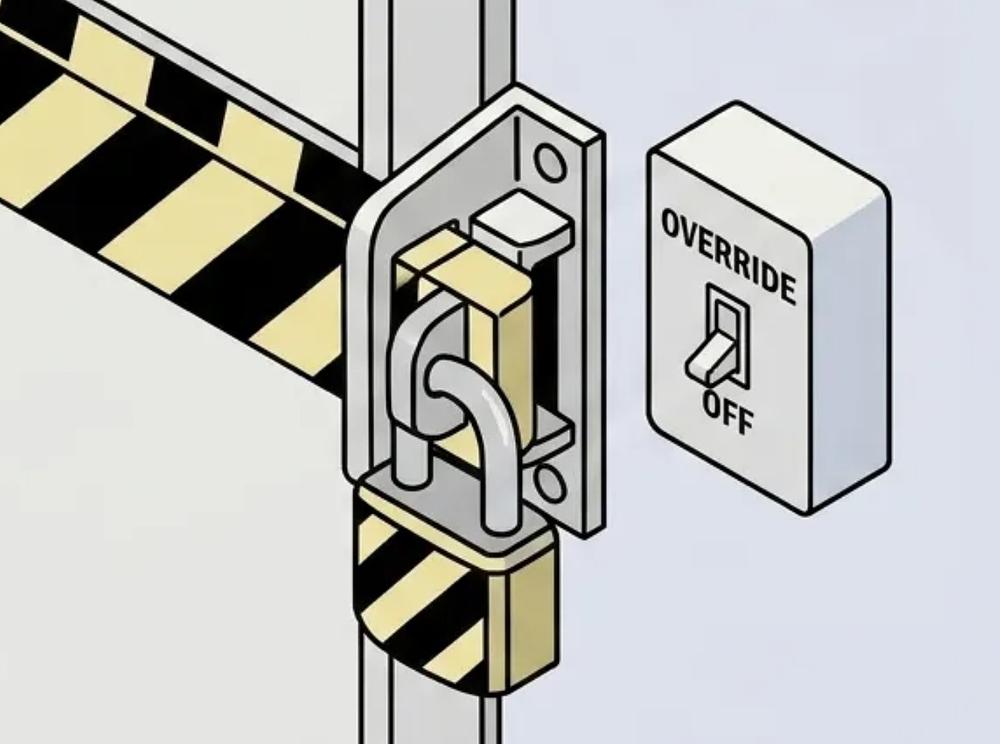
A hard ceiling on destructive actions. Not a warning, not a confirmation, not a checkbox. A refusal. The product knows when the next click costs the user more than they would knowingly accept. Build that knowledge into the interface and let it block by default.
Explicit opt-out, not opt-in. The user who needs the override has to find the setting and turn it off. Inertia is the most under-used trust signal in product design.
A public, dated, structural record of what changed and why. Not a tweet. A page or governance forum entry that names the cause, separates it from things it is not, and links to the specific change. The audience is the next prospect who Googles your brand plus "exploit" or "outage" three months from now.
An on-site /security page that reads like a record, not marketing. Audits dated and linked. Backstop coverage in exact dollars. Risk categories in plain language. Aave's /security is the cleanest public reference; the format is copyable in a single sprint.
What today looks like
Open your own product in a private window. Trigger the most destructive action a real user could take in one click. Note whether the interface warns, locks, or refuses. Then search your brand name plus the worst word a churned customer would type and read the first page.
If the destructive action only warns, and the search result is not a page you control, the same operational habit is producing both. Aave shipped Shield in four days. They followed it with two months of structural responses to a separate $230M event. The pattern is not technical. It is a willingness to make the harder design choice once, then a second and third time when the next event demands it, instead of accepting the support load forever.
Key takeaway
A warning the user can dismiss is not a safeguard.
SOURCES
- The Defiant: Aave launches Aave Shield following $50M token swap loss
- Unchained: Aave and CoW Swap dual post-mortems detail the $50M DeFi swap disaster
- Chainalysis: Inside the KelpDAO Bridge Exploit
- CoinDesk: 2026's biggest crypto exploit, Kelp DAO hit for $292M with wrapped ether stranded across 20 chains
WHEN THIS DOESN'T APPLY
Doesn't apply to labelled-beta or research surfaces where users explicitly opted into raw access. Refusal patterns there infantilize the audience who came for early-stage tooling.
By Dmitry Chernov /
Web & Product Architect
Web & Product Architect
I run fixed-scope website audits across 4 pillars (brand, UX, UI, conversion) for founders building AI/ML startups, B2B SaaS, Dev Tools, and Web3 products. 14 years in design. 170+ shipped, 20+ in Web3.
Available
/
UTC+4
/
05:33
Keep reading
Audit notes
UX Design
Web3
$50M lost. Because of bad UX.
Mar 2026
/
2 min read

UX Patterns
Trust Signals
Conversion
Your customers search for their biggest fear about your brand. Your site doesn't mention it.
May 2026
/
14 min read

Thoughts
B2B Strategy
Web3
12 things a fund manager looks for on your website before they invest.
Mar 2026
/
3 min read
.jpg)
Start with a 30-minute call.
Free intro call, no commitment. You'll leave with 2 – 3 specific observations about what's costing you conversion before we discuss the audit.
Dmitry Chernov
Web & Product Architect
AI, SaaS & Web3
© 2026 Dmitry Chernov. All rights reserved.