← All writing

Web3
Trust Signals
Let buyers verify your proofs. Don't just show logos.
Three Web3 protocols turn "trust us" into a two-second click. The gap between a logo strip and proof is whether the visitor can check it.
Jun 2026
/
7 min read
By Dmitry Chernov / Web & Product Architect
The analyst who couldn't verify your audit
A fund analyst opens your site to decide whether to invest. They scroll past the hero and land on a row of audit-firm logos. ChainSecurity. OpenZeppelin. Trail of Bits. The right names. They go to click one, because their job is to confirm the engagement is real, not to admire the badge. Nothing happens. The logo is a flat image. They open the page source, and the names they need are locked inside the pixels of a file called logo-00001.png, with no readable text behind it. They close the tab.
That is the whole problem in one scene. A trust claim and a piece of proof are different things. The claim is "we are audited." The proof is a link the analyst can click to confirm it in two seconds. Most sites ship the claim and skip the proof, then wonder why capital reads the page and leaves.
A claim is not proof
In a high-fraud category, a logo a visitor cannot verify is structurally indistinguishable from a logo a scam pasted in. The skeptical reader knows this, so an unverifiable badge does not raise trust. It does nothing, or it raises suspicion. The willingness to let someone check is the actual signal, because a project with something to hide does not invite inspection.
In auditing the largest lending protocols in DeFi, the strongest legitimacy claim on the page was routinely the one a visitor could not verify. The names were real. The audits were real. The proof was rendered as decoration. The work was done and then hidden one technical step away from the person it was meant to convince.
Three protocols that let you check
The protocols that get this right turn every trust claim into an action the visitor can take. Three moves, three sites.
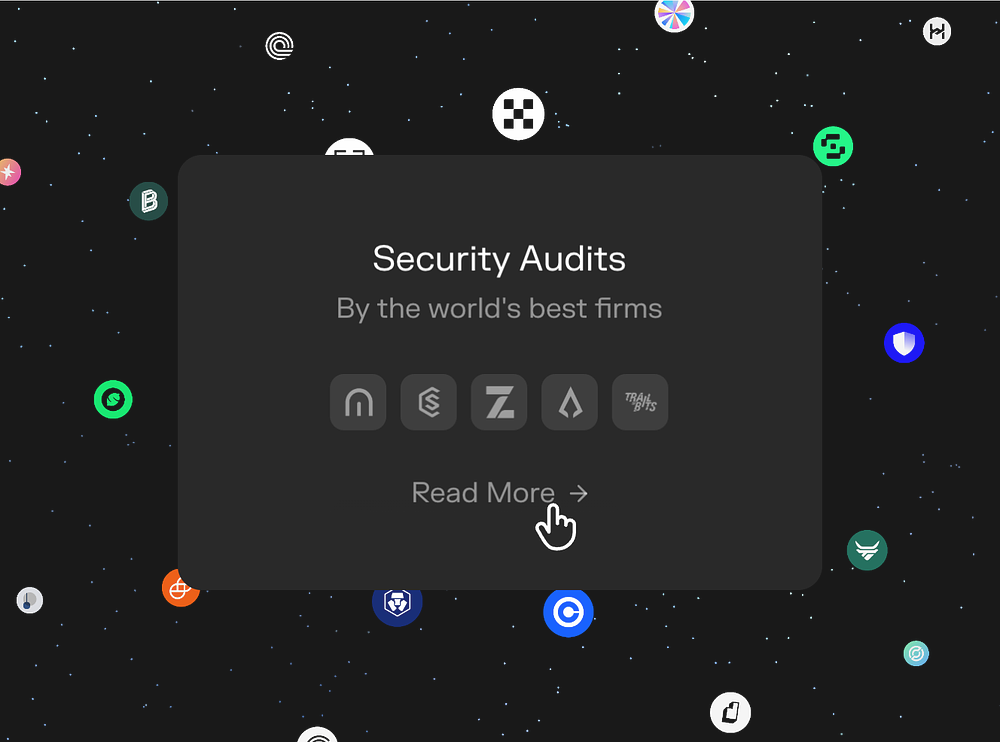
Morpho makes its audit proof checkable on two levels. Each logo in its "Security Audits" block links to that firm's own website, ChainSecurity, OpenZeppelin, Trail of Bits, Spearbit, Cantina, which confirms the firm is real but is still fairly generic on its own. The stronger move is the "Read more" link beneath the block, which routes to Morpho's own audit-reports page where the date-stamped reports actually live, so a skeptic confirms not just that the firm exists but that this specific engagement happened. The same logic runs on its customers: the "Powered by Morpho" section is a constellation of partner logos, each one clickable straight to that customer's story instead of sitting there as decoration. The homepage also embeds a 200-plus-line excerpt of the actual contract source under the line "Open by default, secure by design. See it for yourself."
Aave publishes the exact number. Its security page lists more than 60 audit reports across protocol versions, each with a date and an auditor name, and quantifies the Umbrella backstop as $246,613,412. Not "about $246M." The exact figure. A rounded number reads as marketing. An exact one reads as a fact someone can check against the contract.
Lido grades itself on the attack. It publishes a Decentralization Scorecard on the exact dimension critics use against it, with each module's performance broken out rather than averaged: Curated 98.97%, Simple DVT 98.51%, Community Staking 98.53%, against a network baseline of 98.65%, across 900-plus node operators. Publishing a grade on your weakness, with receipts, reads as accountability. Refusing to grade reads as evasion. Lido runs an audit-transparency section too: "Protected and Verified" names its auditors and states over $4M invested in security.
The pattern is the same in every case. "We are audited" as a logo strip nobody can click becomes logos that link to each firm, with a "Read more" to the date-stamped reports (Morpho). "Our backstop covers losses" as "insured" or "~$246M" becomes the exact figure, $246,613,412, on a date-stamped page (Aave). "We are decentralized" repeated three times as an adjective becomes a public scorecard with per-module numbers (Lido). Same claim each time. One version the visitor can check, one they can't.
These are not three separate philosophies. Morpho, Aave, and Lido are independently converging on the same standard: every trust claim has a link behind it, and the strongest evidence is one click from the homepage, not buried. Once the leaders in a category make their proof verifiable, an unverifiable badge stops reading as neutral. It reads as behind. The bar for what counts as a trust signal is moving, and the laggards now look like the thing they were trying not to look like.
What it costs when the proof isn't clickable
The cost is not aesthetic. It is the check that does not get written. The analyst who cannot verify your audit does not file a complaint. They move to the next deal, and you never learn the page was the reason. The proof you spent real money to produce, the audits, the backstop, the operator set, sits on the page doing none of the work it was bought to do.
The sharpest version of this is a single site running both moves at once. Morpho links its audit logos and its customer logos for anyone to verify, and on the same homepage renders its investor logos as numbered images with no readable names behind them. The protocol's audit and customer proof is clickable. Its "backed by" proof is locked in pixels. Same team, same page, one claim verifiable and one not. The fix on the second one is one engineering ticket, and until it ships, the strongest names on the page are invisible to the analyst, the search crawler, and the AI summary that now does the first round of diligence for the buyer.
Make every trust claim a click
Walk your own page as the skeptic, not the author. Every place you assert trust, audited, insured, backed, compliant, secure, ask one question: can the visitor confirm this in two seconds without taking my word for it. If the audit logo does not link out, if the coverage is a vibe instead of a number, if "decentralized" is an adjective instead of a dashboard, you have shipped the claim and skipped the proof. The reader who needed the proof is the one who was going to pay you.
One refinement separates the good version from the best, and Lido shows it. Verifiable is not the same as legible. Lido does almost everything right, the scorecard, the named auditors, the $4M figure, and then its "See all audits" link routes to a GitHub repository. To a developer, that repo is the source of truth. To the non-technical analyst deciding whether to invest, a raw repo is a wall, not a proof. They came to confirm "is this safe," and they land in a folder tree they cannot read. Morpho and Aave keep the reports on a page they own instead, a /security or audit-reports page that lists each report with a date, an auditor, and a plain-language line. The developer can still click through to the repo. The analyst who can't read Solidity gets something they can actually evaluate. Proof has to land where the buyer can read it, not only where an engineer can.
If you want a second opinion on which of your trust signals actually convert and which are decoration, I pressure-test exactly that in website audits.
Key takeaway
A trust claim your buyer cannot verify in two seconds is decoration, not proof.
WHEN THIS DOESN'T APPLY
Doesn't apply pre-audit, when there is nothing real to show yet. Then honesty about your current stage is the trust signal, not a security page with logos that lead nowhere.
By Dmitry Chernov /
Web & Product Architect
Web & Product Architect
I run fixed-scope website audits across 4 pillars (brand, UX, UI, conversion) for founders building AI/ML startups, B2B SaaS, Dev Tools, and Web3 products. 14 years in design. 170+ shipped, 20+ in Web3.
Available
/
UTC+4
/
09:53
Keep reading
Audit notes
Conversion
Healthcare
12 of 13 healthcare-AI sites are silent about AI hallucinations
Jul 2026
/
4 min read
Audit notes
Conversion
Web3
Your root domain is your front door. Don't aim it at your app.
Jun 2026
/
5 min read
.png)
Audit notes
Conversion
Fintech
Revolut became a UK bank. You can't tell from the homepage.
Jun 2026
/
4 min read
Start with a 30-minute call.
Free intro call, no commitment. You'll leave with 2 – 3 specific observations about what's costing you conversion before we discuss the audit.
Dmitry Chernov
Web & Product Architect
AI, SaaS & Web3
© 2026 Dmitry Chernov. All rights reserved.